Showing posts with label Tamil. Show all posts

Saturday, February 7, 2015

Yennai Arindhaal (2015)

This article is intended for people who have seen Gautham Vasudev Menon's Yennai Arindhaal.

"Yennai Arindhaal" marks Gautham Vasudev Menon's return to action filmmaking for the first time in 9 years. It's another righteous cop story that works better as a romantic family drama than it does as an action film. Ajith, in what I personally think is his most captivating performance to date, gets to play the guy Suriya and Kamal did in the past, and goes on to one-up them.

Stripping the film to its bare bones, it's a story about a boy Sathyadev whose father gets killed (collateral damage, as the boy would one day grow up and say to someone else) by a gangster, and decides (with some inspiration from Alex Pandian) to become a cop to stop people like his father's killer. Although the film's intentionally misleading teaser makes it seem like it's a story about a man having an internal battle between good and evil, in reality, this whole Melisaana Kodu business is as important as a scratch on Sathyadev's Enfield. Menon introduces it, but does nothing to explore the theme. There's no pull of the dark side luring Sathyadev to cross over. There's no evidence to show that, deep down, his chosen nemesis Victor wants to be a good guy. These two people are quite comfortably thriving in their own chosen sides of the melisaana kodu with no moral quandary. For that, you'll have to go see Mysskin's brilliant "Anjaathe". But seriously, what do expect a boy to become besides a police officer when you name him Sathyadev?

Gautham's writing seems to grow just a wee bit with each iteration, and by an iteration, I mean one whole fucking movie. The old tropes are everywhere. Some of these are intrinsic to what we have now come to call "a Gautham Vasudev Menon film". The interiors of houses, cluttered with books on filmmaking; two people bonding during travel; the mild-mannered romance, like an advertisement for Bru coffee; being admirably progressive and celebrating women. But then there are some which only go to show his limited writing prowess - like the part where Sathaydev's father basically rephrases "pursue what your heart desires" from "Vaaranam Aayiram", or the unnecessarily long kidnapping subplot set in New Delhi from the same film, which makes a splashy return with additional details about organ trafficking.

A lot of people have been calling "Yennai Arindhaal" the final chapter in Menon's cop trilogy. When "Vettaiyaadu Villaiyaadu" came out back in 2005, nobody called it a spiritual sequel to "Kaakha Kaakha" - because, let's face it, those two films were quite different. Just because there's a third film now, people are falling over themselves to defend Menon's repetitive narrative choices. Besides, there's so much happening - with the Rise-Fall-Rise structure typical to superhero films - that this one film is a trilogy in itself. A boy is spurred by the death of his father, becomes a cop, excels, quits after lover is murdered on the eve of wedding, takes a long break to bond with his lover's young daughter (All I'm saying is Menon is clearly a big fan of "Thanga Meenkal", a film which he himself produced) from a previous marriage, is forced to return after a friend's daughter goes missing, settles old scores and avenges lover's death. This is pretty good, right? On a story level, the answer is yes, but the end result is a) a resounding no or b) a half-hearted yes, depending on who you ask.

When actresses are offered a role in a Menon film, I'm sure they all want to play the one who dies. Playing the role Hemanika, a classical dancer/single mom, Trisha, the closest thing people of Chennai have to royalty, is breathtaking. These are things that Menon does effortlessly. Sathyadev's personal life is where the film scores.

When it comes to "The Dead Wives Club," Gautham is second next to none other than Christopher Nolan. In "Memento", "The Prestige" and "Inception", and to an extent in the Dark Knight trilogy and "Interstellar", Nolan's protagonists are driven by the death of their wives. The abduction and the subsequent killing of Maya in "Kaakha Kaakha"; Kayalvizhi's death in "Vettaiyadu Villaiyadu" turning Raghavan into an invincible cop with nothing to lose; Meghna's death in "Varanam Aayiram" sending Suriya on an all consuming downward spiral.. and now again in "Yennai Arindhaal", where Hemanikaa is sacrificed to set up a revenge plot. The reason I find this motif problematic in a Menon more than I do in a Nolan is because 3 of these 4 instances were in a cop film. Besides being predictable to the point of amusement, the death of Hemanika is frustrating because it allows us a glimpse at the frayed edges of Gautham's imagination. If there's any upside to this, it's that no matter how short-lived the marriage or the relationship, the guy always gets laid. Doesn't matter, had sex.

Pandian, Ilamaaran, Amudhan - these are iconic villains by the standards of Tamil cinema. The performances may have been too show-y for my taste, but there was a significant deal of intrigue surrounding these antagonists of Menon's previous two cop films. We witnessed them doing horrible things and we knew what they were capable of. In "Yennai Arindhaal", we get a watered-down, one-dimensional, PG-13 bad guy in Victor (played by a devoted Arun Vijay.) He is the name-sake villain here but you seldom see him do really bad things. Sure, he shoots a cop (Michael Mann's Heat inspired this scene, and perhaps more) once, abducts a homeless kid from the street, but that's the farthest Menon is willing to push Arun Vijay. Deciding not to show the grisly murder of Hemanika at the hands of Victor robs the second half and the climactic showdown of serious retributional heft. Instead, Menon chooses to play it out like a twist near the end, to Sathyadev and to us. And that didn't work for me at all because, by this time, Hemanika is a distant memory. A few months from now, I don't think I'd remember anything about Victor - because what does he really do anyway? 

For the sake of argument, imagine that Anbuchelvan, Raghavan and Sathyadev are all the same person. I am sure it's not a stretch. Now allow me to collectively refer to this person as "the cop". So here's the pattern: if a part of what happens in "Vettaiyaadu Villaiyaadu" was the life lead by the cop after the events of "Kaakha Kaakha", then, as a friend suggested, a part of what happens in "Yennai Arindhaal" is the life lead by the same cop had Aaradhana died at the end of "Vettaiyaadu.." and left him with the daughter. It fits, right? It's basically a same person who soldiers on as people he falls in love with keep dying one after the other. Now, calm down, people. Let me assure you this "cop trilogy" is not the result of some grand design. It just goes to show just how badly Menon is in need of a writing partner. Also, here's wishing good luck to the character played by Anushka.

It's also not a smart film. Besides Ajith, every other cop is shown as an inept fucking idiot. Even as a police procedural, it doesn't deal with an interesting subject. It's slick, sure, but intelligent it is not. The intermittent humor is quite pleasant, I must say - a risk, as in the past, Menon neatly pulls off. Going into this film, I thought it was rather admirable of Gautham to ask for help because he was apparently struggling to complete the film. I don't see any of Kumararaja's "touches" in the final film and I'd love to be enlightened if you felt otherwise. In the final 30 minutes, Menon attempts to create tension through dynamism, the way director Hari does so often, keeping characters constantly on the move. But it doesn't really help. "Yennai Arindhaal" is an uninspired rehash of everything Menon has done in the past and doesn't really amount to much.
Friday, January 16, 2015

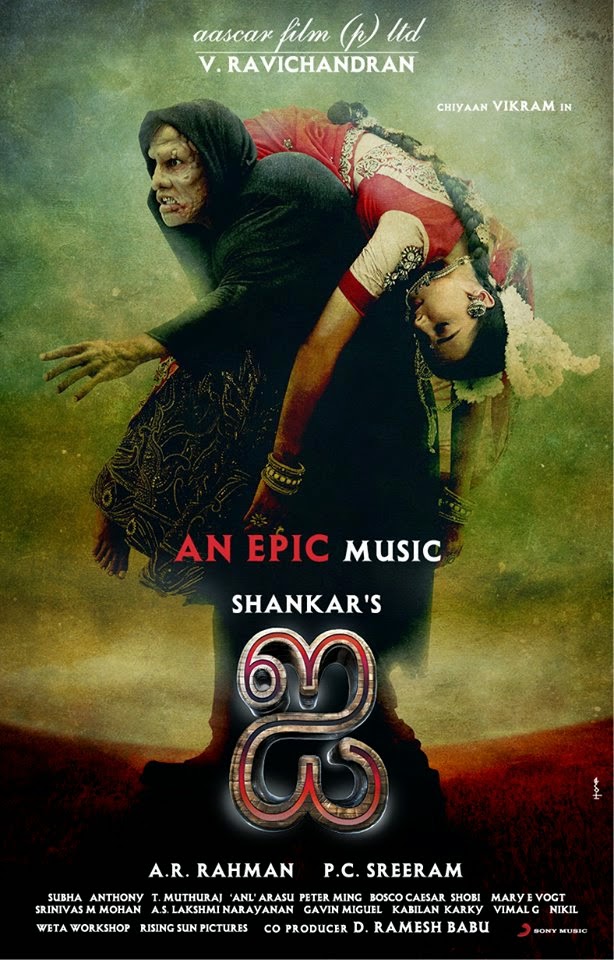
I (2015)

Arguably one of the most expensive pulpy, B movies in the history of cinema, Shankar's "I" is a classic tale of revenge about a simple man who, in pursuit of love, makes too many enemies, gets wronged, and eventually avenges them. Suffused with the opulence that Shankar's films are most well-known for, "I" has the technical finesse which was amiss in his previous films. Yet, "I" is a spectacular misfire -  a supremely predictable trashy genre fare with a muddled voice, a rotten heart and a misplaced moral centre.

Shankar has never been an economical filmmaker, both in terms of storytelling and especially when it comes to being extravagant (or reckless, depending on who you ask.) He is a man who has built a career on vulgar wastefulness and 'subtle' is a term that has seldom been used to describe any of his films. Returning three years after "Nanban", and for the first time with an original screenplay since the demise of long time writing partner Sujatha, Shankar's indulgence appears to have largely gone unchecked in terms of political correctness (or basic decency) and particularly when it comes to thematic clarity. In terms of a physically damaged protagonist hunting monsters who ruined his past life "I" is like "Ghajini". But "Ghajini" had one villain to vanquish - the kingpin. "I" has 5, though that is not why it is a lesser film. It fumbles big time because all 5 of them are on an even keel in terms of importance. "I" is "Kill Bill" without a Bill. It is a film that, by design, is doomed to dissatisfy.

Despite missing the fervor that put the grandeur typical to his films into perspective, the structure is quite admirable for the entirety of first half, with Shankar never resorting to over-explaining. The narrative shifts back and forth, switching between the past where Lingesan aka Lee is in the act of unwittingly making enemies, to the present, where a disfigured Lingesan, one by one, subjects his victims to brutal physical injury. It's when the timelines converge that non-twists are hyped up like twists and the film suddenly starts over-explaining the shit out of developments so obvious that it's kind of unbelievable a director like Shankar thought them to be unpredictable. The relative economy of first half is over-compensated by the expositions in the second.

Vikram, in his most physical role to date, stars as a bodybuilder who becomes a model and then loses it all. For a change of pace, we have a sensible female lead character in Amy Jackson's Dia, but with Vikram portraying a close version of the "loosu ponnu" archetype. He's an unreasonably chirpy and naive man, unconvincing in his half-baked North Madras baashai, but with a penchant for violence. Think Ambi with Anniyan's fighting genes. There's a chasm of class difference between Lee and Dia, an elephant in the room, that the film acknowledges. Mersalaiyitten is itself a self-contented celebration of this divide - an acceptance by Lee of his own huge complex. But then the are the circumstances under which the two meet again. And it's just plain, shoddy writing. Here's where Vikram's performance is pretty terrible. "Look at me! I am ACTING!" A lot will be said about his physical performance but without the crutch (or excuse) of prosthetics, his performance is severely lacking. Not once does he convince you of his "North Madras-ness", the way Kamal has done in the past, or the way even Santhanam very casually does in this very movie.

If you are someone like me - someone who gave Shankar way too much credit - you too are likely to spend most of the first half frustratingly breaking your head over what is it that he is trying to convey with this film. Is this film about extreme obsessions of fan culture? Or about the lack of inventiveness in advertising, maybe? Is it eventually going to make a statement, hopefully with subtlety, about the hollowness of appearances? Will it shame society for marginalising the transgendered community? Will it teach its audience a thing or two about empathy for the differently-abled? Sooner or later, like me, you too will stop looking for a subtext and resign yourself to the fact that there isn't one. In hindsight, I find it absolutely ridiculous that I lent Shankar even that much of credence, painfully analyzing why he was being such a pig headed transphobe and shockingly insensitive towards disabled.

There's something unsettling and perverse about Lee fiendishly deriving pleasure in hurting someone to the point he does, revenge it may be. On a baser level, this whole adukkum melai business is exactly what sick, jilted lovers think when girls turn down their advances. That's the reasoning behind the bad guys seeking to destroy the one thing about Lee that has resulted in their undoing: his beauty, his physicality. Tying this idea to the bad guys makes sense because, obviously, they are bad guys and its a horrible thing to do to anyone. What Shankar doesn't realize, perhaps does and simply doesn't care, is that, without just vanquishing, making his bad guys taste their own medicine, all at the hands of the hero. There's no difference between the two sides anymore. It's irrelevant who drew first, especially when you were never really fond of the hero in the first place. Worse is Shankar having Santhanam's tragically unfunny character go around rubbing salt on the wounds of Lee's victim. What reaction does Shankar expect from his audience during this scene? Laughter? Some people laughed, but I squirmed. 

I have no qualms with Shankar revelling in stereotypes. The promiscuity and low morals of people from the fashion industry, evil multinational corporations, pervy doctor uncles, the virginal and "pure" lover, gangsters from North Madras - go ahead, have it all. But there needs to be a limit to the chest-thumping idealism in his films that more often than not reek of hypocrisy. Big corporations, soft-drink companies especially, have become convenient punching bags for "socially conscious" sub-plots, with Vijay Mallaya as the poster child, embodying everything that's wrong about them. "I" is one of those Shankar films where he does not keep us busy watch him peddle grandstanding social reforms or his protagonist hand out impersonal justice. This brings into focus his world-view, and, my God, what a regressive outlook it is.

Shankar has the sense of humour of a horny 14 year old, but raunchiness is a-okay in my books. He casts someone from the transgender community for the role of someone from the fashion industry. Another stereotype, but I'm willing to cut him slack. What makes me absolutely furious is his treatment of the character in the hands of the film's "hero", especially when there was no obligation to cast a transgender in the first place - unless, of course, he was making a point about gender violence and marginalisation. Cinema is a powerful medium and filmmakers have the responsibility to, if not help emancipate, at least refrain from causing further trouble. Trust me when I say I have thought about this element in the film for a long time since watching the film and there's no way to justify Shankar's insolence. Even if I were to watch the film in isolation, away from the people relishing the drab scenes, I am sure I still would have been offended because this is not a case of audience misinterpreting a director's intentions. He could have done wonders for the community if he boldly chose to. Instead, he chooses to be so detrimental that it makes my head reel. He is not just ridiculing them the way all minimally talented Indian directors do.  I don't say this because Shankar is one of our country's leading directors but because of how relentless his film is in destroying the pride of the said character - even making Vikram utter a line that basically meant "know your place." One day in future, when majority of Indians, hopefully, would have realized the magnitude of injustice directed towards the transgender community, we will look back in horror that we let a filmmaker like Shankar run amok spewing insensitive and ignorant ideas. "I" would be 21st century Tamil cinema's "The Birth of a Nation"; an albatross around its director's neck.

Clearly out of ideas, Shankar is very close to becoming just a glorified music-video director. In terms of visual grandeur, other directors have caught up and his monopoly has waned. It's high time he stopped thinking in terms of money shots and set pieces and concentrated on a better script. Vikram's efforts are commendable, but seem like an overkill - mostly futile and unnecessary, when less would have sufficed. Amy Jackson is very good. Taking everything into consideration, there's not much left to make "I" worthy of an audience. It's just not fun enough to overlook its flaws. Also, Shankar, please make up your mind about what "I" means. Is it the name of the Mallya lookalike's company or the name of the virus? Or perhaps something that's good? I mean, why else would the two lovers run around singing it? Oh, and in case you are having trouble telling who the bad guys in "I" are, just look out for the people who are smoking a cigarette. Ingenious filmmaking!

Sunday, December 14, 2014

Lingaa (2014)

Rajnikanth's sixth film of the 21st century is an unsurprising disappointment. A loosely plotted film which generously borrows tropes from the actor's previous films, KS Ravikumar's "Lingaa" tirelessly references works from the actor's illustrious past without building anything original of its own that would stand the test of time and be worthy of being looked back at. The writing is dated and lazy, and the general sentiment of the film seems to be embroiled in old values, completely out of touch with times. Other than clearly being a hastily made cash-grab, it is a failure on multiple levels, with none of the contributors coming through to make this film the special event of the year that it was supposed to be. It's frankly insulting to fans of Rajnikanth and to the superstar himself, who is let down on all fronts.

Monday, September 29, 2014

Madras (2014)

This article is intended for people who have seen Pa. Ranjith’s Madras.

Set in Vyaasarpadi, "Madras" tells the story of the residents of housing board apartments who are caught up in a turf war between two political parties. In an expository prologue, a narrator establishes the film's primary conflict - whoever controls a particular wall of an unfortunately located apartment gets to establish themselves as the stronger of the two parties, thus cementing political success. Disregarding the nitty-gritty logistics, on a baser level, the issue boils down to show of power, the wall holding the key to all the problems for the stakeholders. It's a simple, yet potent and compelling premise that ever pivots around this sevuru. Painted on the wall is the face of a dead man whose son Kannan is a member of the incumbent political party. Hidden behind a huge mustache, always lit up in the dark, ever appearing to be in a smile mocking the people caught up in this senseless mayhem. It's a territory war saga that has trickled down generations, destroying too many families, taking too many lives, with a ceasefire offering only temporary solace.

Sunday, August 24, 2014

Kathai Thiraikathai Vasanam Iyakkam (2014)

The most admirable aspect of "Kathai Thiraikathai Vasanam Iyakkam" is that it is not a product of some industry newbie, but a filmmaker who has clocked a little over three decades. In its intentions, "Kathai Thiraikathai.." can be looked at as a less subtle companion piece to "Jigarthanda". While the latter was a pissed off condemnation of the system, this film is an understanding acknowledgment of problems in Tamil cinema. Director R. Parthiepan doesn't preach, and the attitude is anything but holier-than-thou. It's a film with a bit of everything; ideas are tossed all around to see what sticks. And when a film is about nothing, it is, intentionally or otherwise, about everything. It's a story of a filmmaker suffering writer's block; about his deteriorating marriage; a meta movie within movie; a high concept science fiction and even a murder mystery. As intended, the plotting appears arbitrary, but is, in fact, always deliberate, ever in an attempt to make a bigger point.

Friday, August 1, 2014

Jigarthanda (2014)

It's always delightful when young filmmakers show ambition in technique. One of the earliest scenes in "Jigarthanda" is a long take which, although only runs for less than half a minute, is nevertheless a pleasant sight. It follows a young man as he makes his way onto the stage of a reality television show about film-making. The buildup he gets will have you believe otherwise, but the young man, one of the four contestants on the show, is a tongue-tied nervous wreck waiting for the jury to announce their verdict about his short film. A highbrow film director calls it a "kuppa padam". A lowbrow film producer, who wears his heart on his sleeve and his dislike for the director on his face, calls it the "bestu padam". Chaos ensues and the young filmmaker somehow lands a one film deal with the producer to make a blood-curdling gangster film. So off goes our hero Karthik Subramani (Siddharth) in search of a story to Madurai, the land of barotta-mutton chuka, jigarthanda and crime. He picks his subject: Sethu (Simhaa), a gangster at the top of his game. And then he observes.

Sunday, March 23, 2014

Cuckoo (2014)

Have you ever noticed how your jaw starts to hurt a bit after you cry a lot? Well, that's exactly what happened to me as I watched director Raja Murugan's phenomenal debut "Cuckoo". It reveals to us a world of people who have been living right in front of our eyes for all this time. While I believe no human should ever be bereft of any of the five traditional senses, there's something particularly cruel about blindness. We all must have noticed how visually impaired men and women come together and live as a family. They marry either because it makes sense from a financial point of view or just because they are in love. This is one such love story where the possibility of love happening at first sight is nonexistent. And what a love story it is!

Monday, January 13, 2014

Veeram (2014)

How seriously can you take a film that tries to milk sentiment out of its star's salt and pepper look? The answer is: not very seriously. No matter how you see it, director Siva's "Veeram" is an awfully trite movie. It is absurdly predictable and throws cliches at us two at a time. I'd like to say there's a method to its madness but that would be far from true. Yet there's something about it that keeps it from being completely useless.

Friday, January 10, 2014

Jilla (2014)

Director R. T. Neason's "Jilla" reduces Mohanlal into being a narcissistic caricature with a God complex who converses only in punch dialogues. His Sivan is a feared Don in Madurai who makes his victims perform a version of seppuku where they are supposed to slit their throat instead. He adopts his driver's son after the boy's father gets killed by a policeman. The son Sakthi (Vijay) grows up into a classic porikki, becoming Sivan's right hand man. They are pretty much the same kind of unsympathetic people like Simmakkal Ravi, the villain in "Pandianadu". But the film glorifies them and tries to lend them some dignity when there is none to be deserved.

Wednesday, December 25, 2013

Madha Yaanai Koottam (2013)

"Madha Yaanai Koottam" has one of the most notably structured opening scenes in recent memory. If Francis Ford Coppola's "The Godfather" begins with a wedding and introduces us to the various members of the Family, "Madha Yaanai.." instead uses a funeral to similar effects. A patriarch is dead and the wake organized for him is so grand it could be mistaken for a wedding - if not for the long faced men and the wailing women. We get acquainted with the various members of the family - both immediate and extended - and slowly learn about the simmering differences prevailing in the household.

Tuesday, December 24, 2013

Biriyani (2013)

It's been six years since Venkat Prabhu wrote and directed "Chennai 6000028", and he has went on to release four more films in that time. Most have been a commercial success but none had the warmth and realism of his debut film. Some people just cannot handle the scale, and this his true in Venkat's case. The bigger his films got, the less relatable they became. They continued to have these minor touches that made them uniquely his, but they also became more and more indistinguishable. Anyone could have made a "Mankatha" or, yes, even a "Biriyani".

Friday, December 20, 2013

Endrendrum Punnagai (2013)

"Endrendrum Punnagai" is not a film about the lives of three friends; it is about one despicable, self-centered and maddeningly unreasonable man who happens to have two friends. Gowtham, Sri and Baby are inseparable chaddi-buddies who run an advertising agency together. Due to his Mommy issues, Gowtham has a strong aversion towards womankind and, for some reason, expects his friends to remain bachelors for their life. Due to his Daddy issues, Gowtham is not on speaking terms anymore with his Father. Time decides to test their friendship.

Friday, December 13, 2013

Ivan Vera Maathiri (2013)

In the opening scene of "Ivan Vera Maathiri", the horrific incident which took place in 2008 at Dr. Ambedkar Law College where young men brutally savaged their fellow students is recreated. But the reason, unlike in reality, is far more petty. A big politician with a bruised ego orders his men to riot inside the college premises after being refused a seat for someone he knows. With cameras capturing the raw act and cops refusing to intervene, the incident becomes a headline and captures everyone's imagination. The politician's involvement is a common knowledge yet he faces no repurcussions. There's disgust and anger in everyone's voice, but nobody does anything about it. Except one guy.

Friday, December 6, 2013

Kalyana Samayal Saadham (2013)

Arranged Marriages are like dark clouds looming over the heads of self-respecting single people in their mid to late 20s. There's a degree of helplessness about letting parents find the "right" partner, but there's also this sense of inevitability attached to it. Spending a lifetime with someone you know well is itself a frightful prospect; doing the same with a total stranger is most likely to be worse. But it has been happening all around us and most marriages seem to tick. "Kalyana Samayal Saadham" is the story of a girl and a boy of "marriageable age", who are gently nudged into matrimony by their parents.

Sunday, November 24, 2013

Irandam Ulagam (2013)

Nearly a decade ago, Selvaraghavan made "7/G Rainbow Colony" which told us there is life after love and how suicide is not a solution for heartbreak. A decade later, he gives that message a fantastical twist, asking us to go a step further in reclaiming lost love - even if a step means traveling to a parallel reality. "Irandam Ulagam" is mostly a populist RomCom in the clothes of a high-concept sci-fi fantasy. It is the journey of a Vinod or a Kathir in search of his Divya or Anitha.

I cannot be entirely sure just how much Selva has fumbled here in relation to that one previous big-budget film of his. I haven't seen "Aayirathil Oruvan", but I massively respect the fact that a director took it upon himself to give the people a fantasy film about our absurdly rich history. The same cannot be said for "Irandam Ulagam"; what it lacks in originality, it also lacks in clarity. The end result is a messy compound of undercooked ideas wrapped inside an incoherent and bloated narrative. It's hard to believe someone like Selvaraghavan has made such a corny film about "pure love" and "all the Universe conspiring in helping a person achieve it."

I like how the film didn't resort to excessive spoon-feeding and jumps right into the narrative, expecting us to keep up. We are introduced to our two pairs of protagonists, living in two different worlds. Anushka is Ramya and Varna, and Arya is Madhu and Maruvan respectively on Planet Earth and Planet I-don't-know-where. Selva uses a modern-day setting just to ease audience into a world which is completely strange to them. The two love-stories, if we can call it that, run parallel before it's time for these worlds to collide. Here's where the abstraction begins to take its toll on us. There are long stretches of scenes which make very little sense. To make things worse, an abrupt and unconvincing tragedy is forced upon us.

We don't know if a portal opened on its own to let Madhu in or if this particular Oracle lady, played by a Kalki Koechlin lookalike, made it happen. The Oracle's role in the Kingdom and in Maruvan's family is never explained either. Then there is a subplot about an ongoing war with a neighboring kingdom that felt severely under-explained. It's also very hard to believe that a world, this world in particular, could exist without love. It's such an incredible idea which is so under-explored that it becomes maddening after a point. The film is only too happy to keep aside its ambitions in favor of love failure songs. I just hope Selva doesn't blame the film's failure on audience's inability to comprehend what he's trying to say. It's a poorly directed film and that's the only truth.

You are not in Koyambedu anymore. Myth building is perhaps not Selva's strong suit and his version of Pandora is a proof for that. The issue is not the quality of CG at all; it's just that there's no visual consistency throughout the film's runtime. The geography and its other defining aspects are confusing to say the least. The sky looks different in each scene, populated with distant stars and galaxies thrown together haphazardly. The flora and fauna looks heavily inspired, differing only due to unintentional discrepancies. The natives are all Caucasians with the exception of our protagonists. The derivative nature of the world is a problem especially because all these elements come together and create something improbable. Selva expects audience to take his creation seriously, but won't return the favor by offering a little more insight about the science. But I have to admit the work on one particular variant of a lion was pretty stunning. Sitting two rows from the screen, I found it deeply unsettling.

On the surface, it may be about a man's search for lost love, but beneath the layers of tacky visual effects, I have reasons to believe "Irandam Ulagam" dealt with one unifying theme: feminism. At the very beginning, we are told that the parallel world, the Irandam Ulagam, never prospered because their people never learned to love; a world where the thought of getting a woman's consent never crossed the mind of a man; a world where rape is the natural state of order. Selva gives primeval characteristics to the natives which sadly seem to exist even today in our "civilized" society.  Selva provokes us to think about the world we live in and how we treat our women by drawing parallels which should have ceased to exist long, long ago. He talks about dwindling sex ratio and how turning down a woman's proposal is the worst thing one could do in this day and age.

Maruvan conquers a feared beast to keep Varna from falling onto the bed of the King, but this understandably doesn't sweep her off her feet. It's still an agreement between two men, with no place for her consent.  She would even kill herself rather than be married to a man (why this world even has a system of marriage, we will never know.) Varna eventually has a change of heart towards her man. There's a crackling scene where Varna and Maruvan draw swords at each other in the middle of their fight with a common enemy. Perhaps that's the only way to solve the menace of inequality. Together. But the lines often get blurred and the subtext doesn't reflect coherently on the screen. Who are those people in black robes who want to create a world with one king, one religion and one God? What do they represent? How can a world that doesn't respect women be revering a female prophet? Is she a slave to them? It's questions like these that keep me up at night.

I cannot imagine any other actor besides Anushka to play the female lead. The character demands a big girl and big is what she is. In spite of being a fairly lengthy film, there are many scenes in the film which feel rushed. Maruvan goes from being a village bum into an invincible warrior of sorts in the blink of an eye. He becomes so good at fighting that the clashes at the end become pointless. The idea of a kingdom which is on the cusp of experiencing love for the first time is all good, but Selva does too little where there was scope for so much more. And he does it with utter lack of finesse. For all I know, thematically, the film might not even be as deep as I am willing to give it credit for.

Monday, November 4, 2013

Arrambam (2013)

If watching Ajith put his sunglasses on while walking in slow motion to an abused theme music is your idea of a good movie; if you have no trouble rooting for a character with inarguably messed up moral issues; if you think consistent logic is not an imperative element in a script, then "Arrambam" is the film for you. You two deserve each other. For the rest of us who expect more, this thoroughly joyless film will seldom offer any of it. 

Vishnuvardhan knows only one way to make his films chic - by populating them with good looking people using bloody expensive things. It worked for him in "Billa" because, let's face it, we had never seen anything like it before. He had the liberty to go the distance in "Billa" because it dealt with people who happened to be filthy rich gangsters. "Arrambam", on the other hand, is a film about a bunch of people who cannot be in possession of that kind of money. The reason is because people in this story are risking their life to bring to justice those very corrupt and powerful people celebrated in "Billa".

But Vishnu wants to have it both ways. He doesn't give up the pizzazz and bestows upon his working class characters a swag life which they could never possibly afford. He has them own cool gadgets, plant fancy explosives, fly around the world undetected, drive Ducatis and own big-ass yachts. Then he also makes them give us a moral science lecture and go all "Rang De Basanti" on a politician who swindles public money.  

Arya's Arjun is the character we are initially supposed to root for. He plays a brilliant computer hacker named who probably owns a special computer with a button that has the words "Start hacking" written on it. Maya suggests Arjun's name to AK (Ajith) because he once hacked into SSN Engineering College's super-protected network and changed her attendance percentage. He is caught with people whose motives remain unknown to us and we are supposed to fear for his life. AK threatens to kill Arjun's girlfriend if he fails to hack into stuff. But the problem is that the girlfriend (named Anitha; played by Taapsee Pannu) is so magnificently stupid that a part of you wishes AK would put us all out of our misery by putting a bullet in her brain.

Vishnuvardhan is a good director.. when it comes to making music videos. Otherwise, there's nothing worthy about his technique at display in "Arrambam". There's a scene near the beginning where Nayanthara gives the fakest performance humanly possible when her character Maya gets abducted by some goons. Are we supposed to be surprised when she reveals that she had been in on the plan all along? Wow. Wonderful piece of direction there, man. You had me good. The style of "Arrambam" is highly derivative and instantly reminiscent of a dozen other movies. A lot of the film takes place in Mumbai, the new terror capital; but unlike, say, "Thuppakki", the city here has no real character and just lying there. But in a film where the characters themselves have no personality, expecting something from the locale is admittedly asking for too much.

Do directors who make films like "Arrambam" really think people of India do not have access to Hollywood films? I am not saying that "Arrambam" is inspired by one particular movie; I am saying that it has shades of one too many typical, dumb American action movies. We have seen those films already and we do not want you to try and fail at recreating the same with Indian actors. Watching you attempt making them is like watching a monkey on a rollerskate. Don't get me wrong; all I ask for is hints of originality in a story with convincingly believable treatment. 

It's a heartless film from an inept director who believes one scene of mass poisoning is somehow enough for audience to root for AK, who himself is misguided and driven by revenge and a misplaced sense of justice. This elaborate scheme to bring down a corrupt politician comes into being after the death of an honest policeman- someone who also happened to be AK's dear friend. He is so overcome by inconsolable rage that he plans to steal zillions of dollars from the offshore accounts of all the dirty Indian politicians. But here's the catch: AK doesn't seem to have a problem that many innocent cops are getting killed along the way. He is shooting point blank at hapless constables who are taking him to prison. How do you expect audience to root for a cause which is reeking with hypocrisy? Don't tell me it was necessary for the greater good. In my book, no amount of money is worth the lives of those nameless cops. Don't give me that macro bullshit when the whole incident was set in motion by something so micro, so personal.

In Ajith's defense, I agree it has become hard for actors like him to break past preconceived notions that his fans hold in their mind. To them, it doesn't matter that their idol is playing a character who holds an iron box a few inches from a baby. If Thala is occupying a frame, they will cheer. But even if you isolate yourself from the reactions of fans, the movie still clearly comes off as to be designed for those very people. Right from the random opening song, it appears to be playing to the gallery. If you take away Ajith's offscreen persona from the character, there's little reason to root for the protagonist. There's nothing inherently cool about his AK. Through the course of the movie, you don't get to know him at all. He is just an amalgamation of certain very generic character traits.

Without getting into the fuckall climax and the absurd epilogue, let me just say "Arrambam" is as sophisticated as that Shut down button in its title art. Perhaps "Make it simple" is not the most appropriate mantra for the film.

Saturday, November 2, 2013

All in All Azhaguraja (2013)

Well, it was bound to happen someday. After three consecutive hits, Tamil cinema's luckiest filmmaker has made a film that's so awful, its success would result in me losing faith in our people. It's not like M. Rajesh is new to making bad movies. I absolutely loathed "Siva Manasula Shakthi" and "Oru Kal Oru Kannadi", but enjoyed "Boss (a) Baskaran" quite a bit. It's just that none of his previous films have been a catastrophe of this magnitude.

Rajesh has made a conscious effort to make his fourth film different from his previous three. The difference is that it showed a hint of having a proper story in its early minutes. But that's where the deceit lies. It's still the same old trash - only less funny and more unbearable. There's Santhanam playing a drag queen for whom an old man develops feelings. Boy, I wonder if this is the first time in our history that a film has tried to milk humor out of a man dressed as a woman. For the sake of tackling a period setting, Rajesh creates a laboriously painful backstory involving Prabhu which does nothing to make the film better. 

Raja (Karthi) runs an obscure television channel and tells his parents that he wouldn't marry until he makes his channel the best in the market. Kalyanam (Santhanam) is a friend/employee/lapdog who continues to stick around and do things for Raja for reasons unknown. Raja is a total loser who does nothing to achieve that goal of his.. a goal which we are made to believe is what driving the film. The moment he meets the girl, he throws everything aside and inadvertently does everything to sabotage her career. The film is over-written with too many subplots, none of which make any sense. 

I had a minor panic attack when I noticed on the Censor board certificate that the film's running time was close to 180 minutes. That's about as long as Francis Ford Coppola's "The Godfather". With only five minutes worth of humor, you have to be on a suicide mission to make such a long film with so little to offer.

"Azhaguraja" is a deeply misogynistic film which treats its lead female character terribly; I felt very sorry for Kajal Aggarwal's Devi Priya. She is the most adorable Grammar Nazi in the world. She shows her displeasure when Raja sends a note along with a bouquet that reads, "I Love U", and asks him to spell 'You' correctly without exactly being a dick about it. There's an excess of the typical OTT elements in her character, but there's some novelty too. She isn't swept off her feet that easily. She manages her father's cinema and wedding hall, and wishes to make a mark in the entertainment industry in some way. But then something very awful happens. She meets Raja who irresponsibly kills her self-confidence and turns her into a consolatory "housewife". He brings her down to his state and eventually makes her say, "I Love U". He domesticates her, that bastard. 

Performance-wise, Santhanam is decent with his peculiar idiosyncrasies. At least he makes an effort. I don't know if it's just me but every time I see Prabhu, I immediately think of his Kalyan Jewellers advertisements. MS Bhaskar is worth mentioning, but that's about it. "Azhaguraja" is punishingly long, achingly unfunny and doesn't deserve any audience at all. Kill it with fire! 

Friday, October 11, 2013

Vanakkam Chennai (2013)

The one big issue with "Vanakkam Chennai" is how familiar it feels. It lets off that distinctive template rom-com vibe and it is never not predictable. Director Kiruthiga Udhayanidhi makes a confident debut that is brimming with visual finesse, but the writer in her isn't very assured. Most of the film's problems are rooted in the script. The lead characters in this Rom-com are basically like a pair of strong magnets who are placed close enough but held apart for 2 hours. We know that they will eventually come together and we will walk out of the theater with a hope that they will stick happily ever after. The trick is to keep us invested till the end. "Vanakkam Chennai" is largely watchable but gets a tad tiring towards the end as it keeps finding ways to delay the obvious. 

After getting duped by a real estate broker, two people find themselves with keys to the same house. Shiva's Ajay is the first to reach the house and wants Priya Anand's Anjali to vacate. Since Anjali, who has come to Chennai  leaving behind her Father in London to find material for a photography competition, cannot afford a new house, she decides to stay there as well. A classic rom-com premise. If you put two genial people together under one roof, no matter what their differences are, they soon start being nice to each other. That's human nature. If they fight like immature babies, like they do in this little film called "Raja Rani", then they are jerks who do not deserve our sympathies. 

The film has a light tone and lead actors are immensely likable. The first half goes without any major hiccups, before the film commits its first big mistake. If there is one movie that could have done without Santhanam - and in case you are wondering, I could name a few off the top of my head - it is "Vanakkam Chennai". At the beginning, the film created a rather not-so-typical character in Ajay and wasn't just a banal movie itself. But then the second half happened and Ajay became just another guy who hung out with Santhanam at a TASMAC bar, seeking ideas to 'usaar' the girl he liked. I believed Shiva was funny enough to carry the film on his own, but the director felt otherwise. Thankfully, Santhanam makes an entry only at the very end of first half, but even that's not late enough. 

The character of Anjali is written as a self-reliant woman who is intent on spending her own money, despite having a rich father (we are reminded of this fact on more than one occasion). She is a smart girl who knows what to say when trouble in the form of a creepy taxi driver is brewing. She seeks legal advice to find a solution to her problem in an unfamiliar city. But then, all of a sudden, she is seen kicking the lights out of four scary-looking, grown up men who try to misbehave with her. This unnecessary scene is a) not funny and b) very uncharacteristic of Anjali. I only hope at least female directors understand that a woman doesn't have to wear pants and indulge in violence to pass off as a strong character. 

Shiva has been so deeply associated with spoofs that it becomes hard to tell if he is being serious during an emotional scene. There's a shot in "Vanakkam Chennai: where Anjali and Ajay are standing on either sides of a door and emoting their heartbreak. I honestly couldn't tell if Shiva was doing the best he could or was intentionally parodying other actors. 

In spite of having every reason on earth to use an airport climax, "Vanakkam Chennai" is kind enough to save us that cliche. But it makes up for this benevolent act by adding a few more instead. There's a foreign mapillai character who is as useless as you would expect. Rahul Ravindran plays Anjali's London fiance Deepak. I am guessing he landed the role after Evam Karthik turned down the offer. A general word of advice to young actors from yours truly: even getting out of friend zone is easy when compared to landing lead roles after getting typecast as an educated, foreign mapillai in Tamil cinema. Then there's that annoying visual cliche where characters clean up a dirty house in a time-lapse shot. Anjali even goes ahead and wins the photography competition. I am a hundred percent certain nobody in the audience remembered the contest, let alone cared about the outcome. Then why did the film go ahead and add one more cliche to its repertoire, when letting Anjali lose would have earned it brownie points from me? Did we learn nothing from "Silver Linings Playbook"? 

Anirudh's music is a huge positive and I can't seem to get a few of the background tunes out of my head. Priya Anand looks utterly gorgeous in every frame. But "Vanakkam Chennai" is still just an okay-ish Rom-com that is hard to dislike. It does very little to reinvigorate a stagnant genre. Also, it should have avoided using Santhanam. 

Wednesday, October 2, 2013

Idharkuthane Aasaipattai Balakumara (2013)

Vijay Sethupathi has proved himself to be a truly versatile actor. He can do all kinds of movies. No, really, he can. With "Idharkuthane Aasaipattai Balakumara", he has convinced me that he can also do absolutely awful movies. But before you call me a crazy contrarian and tell me to go beep myself, let me make it clear that it is not Sethupathi's fault that this movie sucks so bad. 

Another day. Another new Tamil film with a message. I wonder if "..Balakumara" releasing on a dry day like Gandhi Jayanthi is some sort of a coincidence. Because, at heart, the film is a moral science lesson about the ills of consuming alcohol dressed up as a comedy. But since the film is as funny as a screen door on a battleship, all we are left with is the goddamn message. The film has its liver in the right place but the kind of situations the characters are put in to convey the point that "Liquor Ruins Country, Family, and Life" are laughably bad. As if those tobacco/alcohol disclaimers before every film weren't enough. 

Sethupathi  plays Kumar, who in the words of Kumudha, the girl he fancies, is a "love 'kum eve-teasing 'kum vidhiyasam theriyathavan". He calls himself Sumaar Moonji Kumar because some people apparently find that funny. Ashwin plays Bala, a bad boyfriend in the eyes of his demanding girlfriend Renu and an inept employee in the eyes of his tasking boss. That the film blames alcohol for their behavior and not because they are simple, old-fashioned jerks is what I just don't get. Sure, Sethupathi's Kumar is way too likable to fault, but even he goes overboard with his "loosu paiyan" act. 

Saying Writer-Director Gokul's screenplay is all over the place is putting it lightly. A film like "..Balakumara" which follows multiple storylines should be like a house of cards. You take out a single card and the structure is just not the same anymore. A sum of its parts. One could chop entire storylines here and still not miss much. It would still remain the same appalling movie. You just know that paths would eventually cross but there's no joy in watching all these stories connect to each other. 

All I wanted was to see more of Sethupathi. He doesn't get much to play with but he still does everything to lighten up his portions. Humor is subjective and all that but I was completely taken aback by how embarrassingly unfunny this film was. I haven't seen "Va Quarter Cutting" but I did hear some horror stories from people who did. Kumar's search for alcohol in the middle of the night is reminiscent of the former film. 

The other plots in the film include a couple expecting their first child and a wife who has her husband killed by two people who are smitten with her. Why the film even needed a murder mystery is a bigger mystery to me. There's a dead man sitting inside a Tasmac bar and the attitude of people who have something to do with it is so uncharacteristic. In one scene you see the film going all grim during an accident and, moments later, the music is back to its jumpy self. There's even a love failure song which Sethupathi dances to. The jarring tonal shifts belittle the tragedy that the characters are trying to avoid. Nothing is sacred and everything is expendable in the name of comedy. 

I had such a horrible time I regularly contemplated walking out of the movie. But then again, I didn't want to be the guy who walked out of a "Vijay Sethupathi" film. 

Sunday, September 29, 2013

Raja Rani (2013)

Since most people have made up their mind and are going to watch this film anyway, I'm going to indulge myself and get occasionally spoilery here. 

Flash news: There is life after love.

I can see why everyone is truly loving "Raja Rani" or is at least willing to give it a free pass. I really do. It is an easy film to like. It is a very good looking film filled with some very good looking people. I will totally understand if you say you felt nice watching it. We are so bereft of such movies that people have instantly lapped it up without thinking twice. Even some random movie in Hindi, like, say "Kismat Konnection", has amazing production value. It makes me jealous how Hindi film industry has reached a place where pretty, instagrammed visuals is a more of a norm. I do not wish to belittle the film's achievement. I am sure it is really hard to achieve a particular look for a film and I am happy Atlee has made the movie he set out to make. But it is all style and very little substance.

"Raja Rani" is one rare Tamil film with a trailer that actually reveals something about the movie. Actually, it reveals a bit too much, because, thematically, there's little else going on here besides what we see in the trailer. While I appreciate the lack of pretension of being something more, I am also disappointed by how it gives us so little to chew on. One thing I was mildly curious to see was how Atlee had structured the film. I am a silly optimist and I have this tendency to expect intelligent narrative style from young filmmakers. Even though it is predictable, I didn't mind that the film started with the wedding. What bugs me is how lazily the back stories are woven into the whole story. Calling the post-marital portion the "whole story" is not even the right way to describe it considering how little runtime it gets.

27 years ago, Mani Ratnam made this little movie called "Mouna Ragam" which I'm assuming not many of the people who are loving "Raja Rani" have seen. I watched the film only recently so I could read Rangan's "Conversations with Mani Ratnam". I am the guy who had a major problem with Mouna Ragam's railway station climax. For all I know, Mani Ratnam was the first Indian filmmaker to use the now notorious cliche. It's just that I had seen it so often, I had trouble buying it. It was superbly staged and had Revathy saying that legendary, "Vetkathai vittu kekren.." line. Now here comes a movie which is so happy to use the convenient cliche and doesn't even bother to at least do a spin on it. It solely leads to the punchline where John and Regina say that which their respective one time lovers said to them. I agree it's a decent line but the setting is so hackneyed that I couldn't really care.

Ratnam told Rangan how Karthik's character was not even a part of the first draft of the film's script. Ratnam felt he had to add the backstory so audience wouldn't find Divya's actions bizarre. Nearly three decades ago, this man had the good sense to see how the film would have been better without the backstory. Now what have got here? A film with paper thin marital drama and even more redundant flashbacks. But I understand one cannot tell a story about "Life after Love" without showing the previous relationships in some capacity. What I wish Atlee had done instead is come up with some more compelling reason for the husband and wife to fall for each other. What kind of a reason is "I want to fall in love with you because I really enjoyed listening about your previous relationship"?

I found Regina and Surya's story easier to like for two reasons. It had Jai playing a guy with "bayanda subhavam" - someone I could partially relate to. The other reason being Sathyaraj, who is unbelievably cool here. I cannot believe it is the same guy who was in movies like Amaithipadai and Walter Vetrivel. That's one of the joys of cinema, isn't it? Seeing a veteran actor rediscover himself at this stage of his career. His conversations with his daughter are the only parts I wholeheartedly loved. The scene where he visits his daughter for the first time after her wedding (why, yes, another Mouna Ragam riffage) and he sees through her act is good because of him.

Regina waiting all day outside Registrar Office for Surya to show up ( *cough* Mouna Ragam *cough*) is all very filmy and I am a sucker for that stuff. In spite of being generally unimpressed with most part of the movie, there were a few lines which I liked a lot. A tearful John saying "Cha, semma love 'nga" after Regina tells him about her life with Surya is one such moment. Another was Regina telling her father, "Nee shave panniko, naa kalyanam pannikren." How I wish the writing was always this good.

To give an example about the bad writing I just mentioned, let's discuss the other love story. Literally nothing is good about the Keerthana-John relationship. Save me the trouble of going into detail because I hope you too realize that it sucked entirely. Once we are told that Keerrthana is an orphan, we learn that there's no roadblock in their romance. Along with that comes another obvious realization that something is going to run over her; the only question that remains is what kind of vehicle it is going to be. It's a painfully forced tragedy.

Do we go to movies seeking a life lesson? Because "Raja Rani" is handing them out by the dozens. Every lead character, even Santhanam, has something heavy to say about how one should lead their life. All this advice sounds like it is directed at the audience and not at the characters they're talking to. Which I suspect might have been the intention all along.